

How GPS Clocks Work
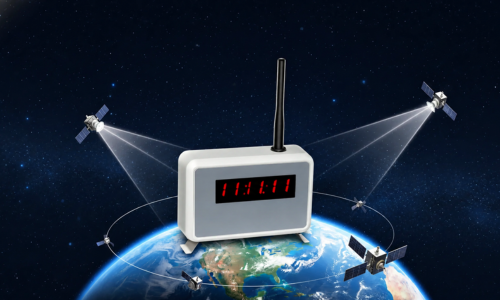
GPS clocks receive signals from satellites orbiting the Earth. These signals contain accurate time and location information. The GPS receiver processes the signals and adjusts its internal clock to maintain precise time.

Features of GPS Clocks
-
High Accuracy: GPS clocks provide extremely accurate time synchronization.
-
Automatic Synchronization: They automatically adjust their time using satellite signals.
-
Global Coverage: They can receive signals in most parts of the world.
-
Reliability: They maintain consistent time without frequent manual adjustments.
-
Automatic Date and Time Updates: They can update the date and time automatically.
Applications of GPS Clocks
-
Telecommunication: Synchronizing mobile networks and communication systems.
-
Banking: Maintaining accurate timestamps for financial transactions.
-
Power Stations: Synchronizing electrical grids and monitoring systems.
-
Transportation: Supporting railway, aviation, and navigation systems.
-
Scientific Research: Providing precise timing for experiments and measurements.
-
Security Systems: Synchronizing surveillance and recording equipment.

Advantages of GPS Clocks
-
Extremely accurate timekeeping.
-
Automatic time correction.
-
Reduced need for manual maintenance.
-
Useful for synchronizing multiple devices.
-
Reliable timing for industrial and commercial applications.
GPS clocks play an important role in modern technology by providing accurate and synchronized time. They are widely used in communication, transportation, banking, scientific research, and industrial systems. Their ability to receive precise timing signals from satellites makes them an essential tool for applications where accurate timekeeping is required.
Hurry up! Contact us today and get
FREE FIRST CONSULTATION